Why You Keep Falling Off Track (And What to Do Instead)

Have you ever found yourself saying:
“I’ve ruined it now.”
Maybe you missed a workout. Ordered a takeaway after a stressful day. Had a week where healthy habits completely disappeared.
If so, you’re not alone.
One of the biggest myths about improving your health is that successful people stay motivated and make perfect choices all the time.
The reality is very different.
Everyone experiences setbacks. The difference is that some people learn how to recover from them quickly, while others get stuck in a cycle of guilt and starting over.
But, falling off track doesn’t mean you’ve failed forever.
The Problem Isn't the Setback
Let’s look at a few common situations:
- You miss a workout because work runs late.
- You eat more than you planned at a family gathering.
- You have a stressful week and rely on convenience foods.
- You skip meal planning and grab whatever is available.
None of these events will undo your progress.
The real problem is often the story we tell ourselves afterwards.
Instead of seeing the setback as a normal part of life, we interpret it as evidence that we’re not disciplined enough, motivated enough or capable of succeeding.
That’s where our thoughts can cause real damage.

Why We See Setbacks as Failure
Many people approach health goals with an all-or-nothing mindset.
The thinking often sounds like this:
- “I was doing so well.”
- “I’ve blown it now.”
- “I might as well start again on Monday.”
- “I clearly can’t stick to anything.”
When we expect perfection, any deviation feels like failure.
But health isn’t an exam you either pass or fail.
It’s a collection of choices made over weeks, months and years.
One less healthy meal doesn’t define your eating habits. One missed workout doesn’t determine your fitness level.
What matters most is what happens next.
How the Failure Cycle Works
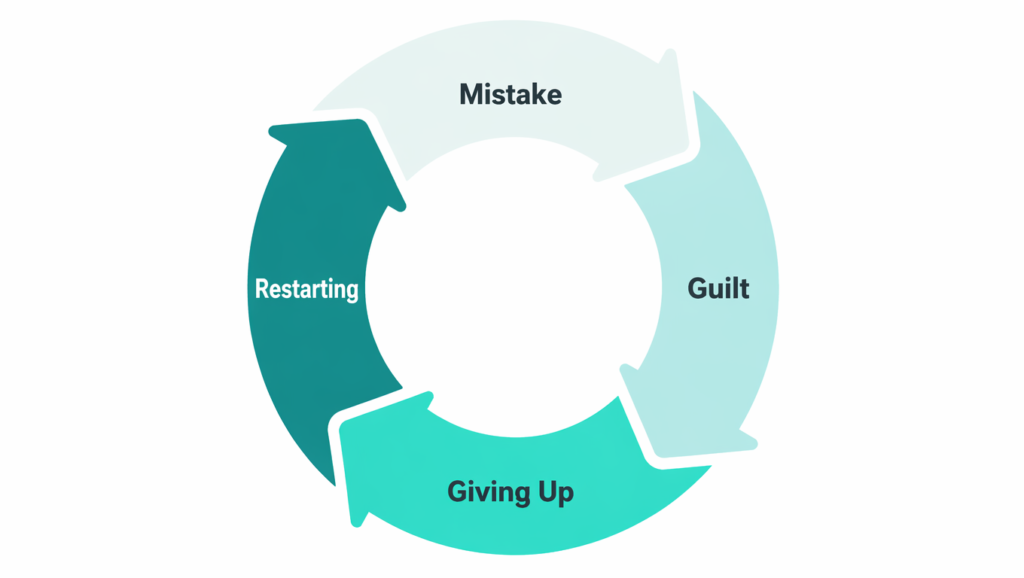
Many people unknowingly get caught in a cycle that looks like this:
Mistake → Guilt → Giving Up → Restarting
For example:
You eat something you hadn’t planned to.
You feel guilty.
You decide the day is ruined.
You continue making choices that don’t support your goals.
A few days later, you promise yourself you’ll start again.
The cycle repeats.
Over time, this pattern becomes exhausting and can damage confidence.
The setback itself wasn’t the problem.
The response to it was.
Progress Beats Perfection
Imagine two people trying to improve their health.
Person A follows their plan perfectly for ten days, then gives up completely after one difficult week.
Person B follows their plan around 80% of the time and keeps going despite setbacks.
Who is more likely to succeed long term?
Usually Person B.
Sustainable health isn’t built through perfection. It’s built through consistency.
Small actions repeated over time will always have more impact than short bursts of extreme effort.
Reframing Setbacks
One of the most helpful mindset shifts is learning to view setbacks as information rather than evidence of failure.
Instead of asking:
“Why can’t I stick to anything?”
Try asking:
“What can I learn from this?”
Every setback contains useful information.
Perhaps:
- Your goals were too ambitious.
- You were relying on motivation instead of routines.
- Stress levels were higher than usual.
- You didn’t have enough support.
- Your environment made healthy choices difficult.
When you become curious instead of critical, setbacks become opportunities to learn and adapt.
Questions to Ask Yourself After a Setback
The next time you feel you’ve fallen off track, pause and ask yourself:
- What happened?
- What factors contributed to this?
- Was there anything outside my control?
- What can I learn from the experience?
- What would I say to a friend in the same situation?
- What’s the next small step I can take?
Notice that none of these questions involve blame or judgement.
Their purpose is to help you move forward.

Building Resilience and Self-Compassion
Many people believe being hard on themselves will help them stay motivated.
In reality, harsh self-criticism often makes change harder.
Research consistently shows that self-compassion helps people recover more effectively from mistakes and setbacks.
Being compassionate doesn’t mean making excuses.
It means recognising that you’re human.
Life will always include busy periods, holidays, family commitments, illness, stress and unexpected challenges.
Resilience comes from learning how to respond to those moments rather than expecting them never to happen.
The Coaching Perspective

One of the biggest benefits of health coaching is having support when life gets difficult.
Many clients don’t struggle because they lack knowledge. They struggle because they lose confidence after a setback.
Coaching provides accountability, encouragement and a safe space to work through challenges without judgement.
Instead of abandoning their goals after a difficult week, clients learn how to adapt, problem-solve and get back on track more quickly.
Over time, this builds confidence and resilience.
The goal isn’t to avoid setbacks altogether.
The goal is to recover faster each time.
Create Your Personal Bounce-Back Plan
Rather than waiting for the next setback, prepare for it now.
Write down:
When I have an off-track day, I will:
- Avoid self-criticism.
- Remind myself that one day doesn’t undo my progress.
- Reflect on what happened.
- Choose one positive action for the next meal, day or workout.
- Continue with my usual routine as soon as possible.
Having a simple plan removes the pressure to be perfect and makes it easier to move forward.
Final Thoughts
Setbacks are not a sign that you’re failing.
They’re a normal part of making lasting changes to your health.
The people who achieve sustainable results aren’t the people who never fall off track.
They’re the people who learn how to get back on track again.
Every healthy choice you make counts.
Every setback is an opportunity to learn.
And every day gives you another chance to continue moving forward.
Elinore x
Ready for Support?
If you’re tired of starting over and want support to build healthy habits that last, health coaching can help.
Together, we can create realistic goals, navigate life’s challenges and build the confidence to keep moving forward, even when things don’t go perfectly.
Get in touch to find out how personalised health coaching can help you stay on track and achieve your health goals with confidence.
Book a free health review call to explore what’s really driving your fatigue and create a personalised plan that works for your lifestyle.
You don’t have to figure it all out on your own.